
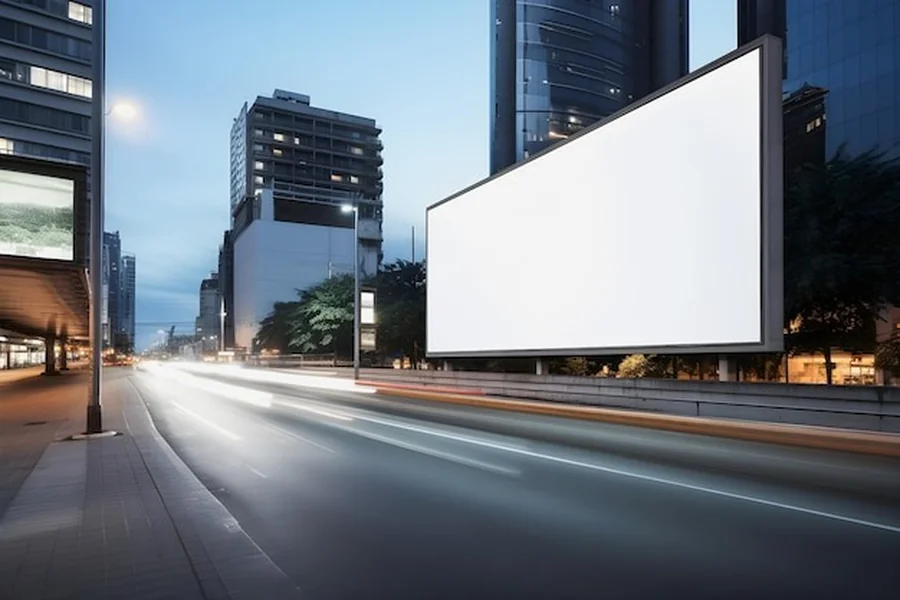
Drive through any city and you will eventually spot them: blank billboards with nothing but white vinyl stretched across their frames, or weathered boards showing only the faded ghosts of previous advertisements. These empty spaces stand out precisely because of what they lack. In a landscape saturated with commercial messages competing for attention, the absence of a message becomes its own kind of statement.
These blank billboards tell stories about economic conditions, real estate markets, advertising budgets, and urban change. They mark transitions, failures, and possibilities. An empty billboard is not just unused space. It is a temporary void in the commercial fabric of the city, a pause in the constant stream of marketing messages that usually fills every available surface.
The Economics of Emptiness
A blank billboard represents a failure of the market to connect supply with demand. Someone owns that billboard structure. It costs money to maintain, to power the lighting, to keep it from becoming a liability. The owner wants to rent that space, needs to rent it to justify the investment. But for various reasons, no advertiser is currently willing to pay for it.
Sometimes the reason is location. That particular spot might have seemed promising when the billboard was erected, but traffic patterns changed, a new highway bypass was built, or the neighborhood declined economically. The eyeballs that were supposed to see the ads are no longer there in sufficient numbers to justify the cost.
Other times, the reason is broader economic conditions. During recessions, advertising budgets shrink. Companies cut back on outdoor campaigns. The billboards that were once in high demand now sit empty, visible reminders of economic contraction. These blank spaces become unintentional indicators of business confidence and consumer spending.
Premium locations rarely stay empty for long. The blank billboards you see are usually in marginal spaces, the ones that were always a harder sell. They reveal the dividing line between desirable and undesirable real estate in the out-of-home advertising market, a line that often correlates with but does not perfectly match other measures of neighborhood value.
The Aesthetics of the Blank Canvas
There is something strangely beautiful about a blank billboard. After the visual assault of hundreds of competing commercial messages, that empty white space feels like a breath. It is not trying to sell you anything. It is not making demands on your attention. It simply exists, a rare moment of visual quiet in the noisy urban landscape.
Some people find blank billboards unsettling, a sign that something has gone wrong. The emptiness suggests abandonment, economic failure, or institutional breakdown. We are so accustomed to every available surface being monetized that unused space feels almost transgressive, like finding an empty lot in a crowded neighborhood or an unstocked shelf in a busy store.
But others see potential in these empty spaces. Artists and activists often view blank billboards as opportunities. Every now and then, a blank billboard transforms overnight into an unauthorized artwork, a political statement, or a community message. These interventions are usually short-lived, quickly covered or removed, but they demonstrate the power of claiming commercial space for non-commercial purposes.
The blank billboard is the closest thing to public space in a privatized landscape. For a brief moment before it is filled with the next advertisement, it belongs to no one’s agenda. It is just there, a neutral surface waiting for meaning to be assigned to it.
Hope in the Blank Space
Despite representing economic failure from the billboard owner’s perspective, blank billboards carry a strange sense of hope. They show that not every surface has been successfully monetized, that there are still gaps in the commercial landscape. They prove that the market is not perfect, that demand does not always meet supply, that capitalism has its limits and failures.
For those who dream of cities with less advertising, blank billboards are evidence that such a thing is possible. They show what streetscapes might look like with fewer commercial messages. They offer a glimpse of an alternative urban aesthetic, even if that aesthetic exists only by accident and only temporarily.
The blank billboard is a promise that things could be different. It is a canvas waiting for something, whether that something is another advertisement, an act of artistic intervention, or simply continued emptiness. In a landscape where every surface seems spoken for, the blank billboard whispers that there is still room for possibility.