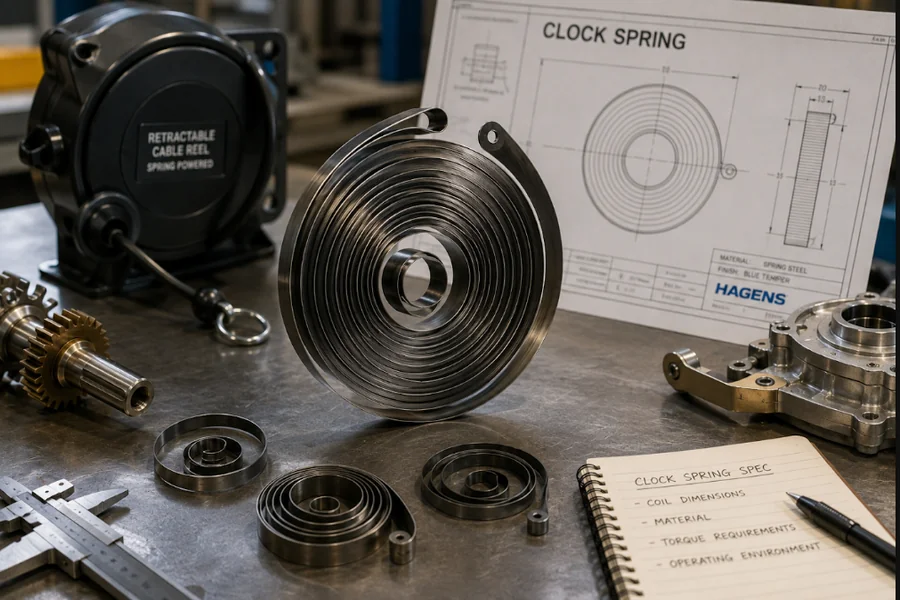
Hagens manufactures clock springs in multiple sizes for a wide range of industrial and mechanical applications, using high-quality raw materials and offering custom design for customers with specific requirements. Clock springs are compact components that store rotational energy and release it as controlled motion, which makes them useful in far more than clocks.
What Clock Springs Actually Do
A clock spring is a flat strip of spring steel wound into a spiral. Turn the arbor at its centre and the strip coils tighter, storing mechanical potential energy. Let it release and that energy comes back as rotational motion.
Springs follow Hooke’s Law, force is proportional to distance moved. For an engineer, that proportionality means the torque a clock spring delivers can be calculated, repeated, and trusted across thousands of cycles.
That reliability is why so many industrial devices lean on stored spring energy rather than a motor or a battery. You see the principle at work in a broad category of spring powered devices, from emergency equipment that must function during a power cut to mechanical timers that keep running without any electrical supply.
Industrial Uses Beyond Timekeeping
Retractable cable assemblies are one of the most common uses. The clock spring provides the constant return torque that pulls a cord or cable back into its housing after use, whether that is a seatbelt mechanism, a tool tether, or a cable reel on industrial equipment. Safety and emergency gear is another area where a device must actuate the instant power is lost, a wound spring is often the most dependable trigger available.
Torque-limited mechanisms rely on them too. A clock spring can be tuned to slip or release at a defined load, protecting downstream components from overload.
Working with experienced clock spring suppliers such as Hagens gives you access to established manufacturing methods and the option of a custom design when a standard size will not do the job.
Clock Springs vs Torsion Springs
Both store rotational energy, so they get confused. A torsion spring is a helically wound wire that resists twisting through a limited angle – think of a garage door counterbalance or a hinged lid. It delivers strong torque over a short rotation and suits mechanisms that only need to move through a modest angle and snap back.
A clock spring works differently. The spiral form lets it accept many full turns of the arbor, storing energy across a much wider rotational range. This is exactly why a retractable reel needing several metres of cable return uses a clock spring rather than a torsion type.
Form factor separates them as well. A clock spring packs usable rotation into a flat, compact disc, ideal for shallow housings where axial length is tight. The right choice comes down to rotation range, available space, and the torque curve the job requires.
Selecting the Right Clock Spring
Specifying a clock spring is a matter of matching four things to the application.
- Coil dimensions. Strip width, thickness, and the number of active coils set both the torque and how much rotation the spring can absorb.
- Material selection. Spring steel is standard, but corrosive or high-temperature environments may call for stainless or a specialist alloy.
- Torque requirements. Define the torque you need at the working position, not just at full wind, so the spring performs across its whole operating range.
- Operating environment. Temperature, humidity, vibration, and duty cycle all shorten the life of a spring that was not chosen for those conditions.
When standard sizes do not cover the requirement, custom-designed clock springs are available from Hagens. It is worth involving a manufacturer early, before the housing is finalised, because a spring designed to fit an existing cavity almost always outperforms one squeezed in as an afterthought.
Why Manufacturing Quality Determines Performance
Two clock springs can look identical and behave completely differently. Inconsistent raw material means uneven hardness along the strip – under repeated cycling, the weakest section fatigues first and the spring loses torque or cracks before its expected life. Irregular coil geometry causes stress to concentrate in the wrong places, and the torque curve drifts as the spring ages.
This is why Hagens builds every clock spring from high-quality raw materials with durability in mind. In demanding industrial settings the component is often buried inside a larger assembly, so replacing it is expensive and disruptive. Precision in the material and the winding process is what keeps it out of the repair queue.
A Closing Thought
Get the specification and manufacturing quality right and you have a component that quietly does its job for years. Get either one wrong and you have an early failure waiting to happen.