

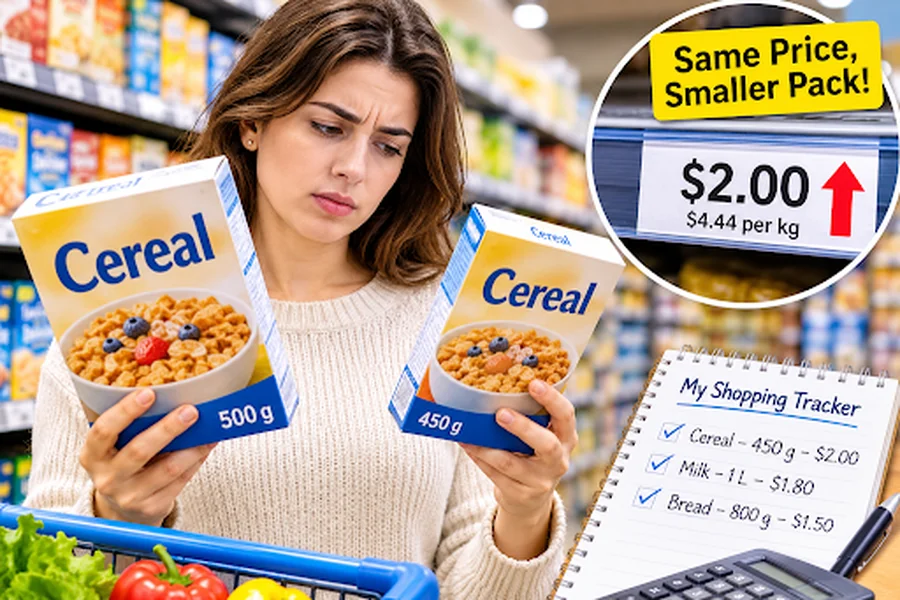
Shoppers have grown used to price rises, but a quieter change often goes unnoticed: the packet gets smaller while the price stays the same. A cereal box loses a few grams, a bottle of washing liquid covers fewer loads, a chocolate bar becomes slightly thinner. Economists call this shrinkflation, and it can raise the real cost of a weekly shop without a single shelf price changing.
The good news is that a few simple habits make these changes visible, and once they are visible they are much easier to manage.
What shrinkflation is and why it happens
When the costs of ingredients, packaging, energy and transport rise, manufacturers have three broad options: raise the price, cut the quantity or change the recipe. Raising the price is the most noticeable, and shoppers tend to resist products that move past familiar price points. Reducing the size by five or ten percent is less obvious, especially when the packaging looks almost identical.
A related practice, sometimes called skimpflation, keeps the size but uses cheaper ingredients or reduces the level of service. Both have the same effect on a household: you receive less for the same money.
Size changes are often easiest to spot on products bought every week, such as snacks, coffee, toilet paper and cleaning supplies. Look at the net weight or volume printed on the front or back of the pack, not the size of the box, since packaging can stay the same while the contents fall. Some consumer groups and newspapers publish lists of products that have recently changed size, which can be a helpful prompt to check your own regular purchases.
Unit prices are the most useful number on the shelf
The unit price shows the cost per kilogram, litre, hundred grams or item, and in many countries shops are required to display it on the shelf label. It is the only figure that lets you compare a family pack with a standard pack, or one brand with another, on equal terms.
Consider a hypothetical example. A 500g pack of pasta costs $2.00, which works out at $4.00 per kilogram. Later the pack shrinks to 450g at the same $2.00, and the unit price rises to about $4.44 per kilogram, an increase of roughly 11% with no change to the sticker. Meanwhile, a 1kg pack at $3.80 is cheaper per kilogram than either, as long as you actually use it before it goes stale.
Building a personal price tracker
Official inflation figures describe an average basket of goods, which may look nothing like yours. A simple list of the 15 to 20 items you buy most often, with their size and price, gives you your own picture. Update it once a month from receipts or online orders, and record the unit price rather than the shelf price.
After a few months, patterns appear. Some products may have shrunk twice, while others have held steady. That information shows where switching brands, buying a different size or choosing a store’s own label will make a real difference, and where it will not be worth the effort.
Smart responses at the checkout
There is no need to avoid every product that changes size. Instead, focus on the items that take the largest share of the budget. Compare unit prices across sizes and brands, and be wary of multi-buy offers that look generous but carry a higher unit cost than the larger single pack. Loyalty schemes, coupons and store gift cards can lower the effective price further, but only when they apply to things you would have bought anyway. Readers who prefer Korean may find 드림기프트 a useful resource in that language.
Bulk buying deserves a cautious approach. A lower unit price only saves money if the product is used before it expires and if there is space to store it without waste.
Keeping it in perspective
Shrinkflation is frustrating, but it is one part of a wider picture of rising costs rather than a separate crisis. The habits that counter it, such as reading unit prices, tracking a personal basket and planning meals around what offers good value each week, also protect the budget against ordinary price rises. Over a year, small percentage differences on frequently bought items can add up to a meaningful sum, which is a good reason to spend a few seconds looking at the unit price rather than the headline figure.